

In October of 2025, the Trump administration approached nine universities with a proposal: universities like Dartmouth and the University of Virginia would receive advantages in federal funding if they implemented policy changes such as editing admissions criteria, culling international admits, and keeping the institutions’ values in line with federal priorities. The schools to which this offer was extended grew to around 100, yet many schools—especially private institutions—declined, as they felt aspects of the proposal threatened their ability to define values that might conflict with federal ideals. Debates have circulated over how these policies affect students and schools overall in their freedom of speech rights. Still, aspects of this “Compact for Academic Excellence in Higher Education” have seeped into university practices, thereby affecting fall 2026 applications and expectations upon reaching campus.
Admissions criteria
Trump’s new college programs affect college admissions from all sides of prospective student identity. The bill said that students could not be admitted based on sex, race, ethnicity, nationality, political views, sexual orientation, gender identity, or religious associations. While some may argue this creates a holistic review process that doesn’t prioritize one kind of student over another, others may say it doesn’t allow campuses to intentionally create diversity. This policy aligns with the 2023 Supreme Court decision to remove Affirmative Action policies, only this time it includes not only race but also gender and other identity points. Some researchers also assert that this policy may be harmful to male applicants. Historically, nearly twice as many women as men apply to colleges (Hechinger Report). Therefore, a given college’s acceptance rate is almost double for male applicants, since many campuses aim to keep the male-female ratio around 50-50. Since the administration has asked schools not to consider gender, men may now have a harder time getting admitted since they’ll be in a gender-blind pool with far more women. Hechinger Report also notes that men have a lower average standardized test score than women, so looking at all applicants without evaluating gender means the ratio of women to men will be far higher in many schools. The proposal also asks that schools reinstate a widely accepted standardized test, such as the SAT or ACT, which many schools have now dropped. The class of 2026 has seen the reinstatement of this test at some schools, a trend that is expected to continue. This naturally affects 2026 applicants significantly, as many assumed that the schools they were considering would remain test-optional for this admissions cycle.
Impact on International Students
The policies enacted by the second Trump Administration have also greatly impacted prospective international students for the 2026 academic year. Higher Ed Dive reports that the state department revoked nearly 8,000 student visas. This was motivated in part by pro-Palestinian campus protests that did not align with the administration’s values. As per the policies outlined above, the administration aims to quell protests, especially when they aren’t aligned with government alliances and priorities. The idea that these campus activities may result in suspended visas has also discouraged international students, as they recognize the implications of freedom of expression on campuses. Moreover, the administration has proposed a rule that caps the time international students have to complete their programs at just four years. This time frame can be extended if students have assessments with the Department of Homeland Security, but this is a hard barrier to break. This change, proposed in August 2025, has yet to be implemented. However, as the Trump Administration pushes for its passage, the programs that international students can complete for the 2026 school year will be limited. In a more straightforward fashion, the administration’s program aims to cap international student attendance at ~15%.

flags. Photo courtesy of Forbes.
Financial Implications
Trump’s higher education reforms will also have financial implications for fall 2026 college students, as the bill seeks to cap the amount of student loan debt students can take on. According to CNBC, the legislation establishes a limit on how much money families can borrow from the federal government to afford tuition: “The new limits on federal student loans include a total lifetime borrowing limit of $257,500” (CNBC). Four years at an in-state public university costs an average of $108,584, significantly higher than the $182,832 average for out-of-state students. At private colleges, this number skyrockets to ~ $234,512 (Educational Data Initiative). So, while this borrowing limit covers many four-year degrees, it leaves no room for graduate programs or for someone to complete their graduation requirements in more than four years. This could create serious financial implications for fall 2026 applicants who take out student loans, as this financing may not be sufficient to cover the cost of the education they wish to pursue. With that being said, the plan has also urged universities to keep their tuition stagnant, meaning it should not increase significantly. This aims to combat the current trend of rising tuition rates.
Campus Life
While many of the Trump administration’s new policies impact the class of 2026 as they apply to college, they will continue to affect the students during their time on campus. For one, Trump’s bill states that “Signatories will revise governance structures, including transforming or abolishing institutional units that punish, belittle, or spark violence against conservative ideas.” Many conservatives hold skepticism towards colleges that they believe now broadly favor a liberal style of thought, thus prompting the Trump administration to seek an implementation of some more conservative ideals. Additionally, the plan proposes a crackdown on campus protests and movements. The bill asks that “signatories commit to using lawful force to maintain order and prevent disruptions to classes, study areas, or access based on protected characteristics.” As demonstrated by the impact protests had on an international student, these impacts affect students’ freedom of speech and freedom to organize. Tied back to the gender criteria discussed in admissions, Trump’s proposal reinforces the idea of there being only two genders—male and female—which is changing how schools teach gender. For example, Texas A&M announced that it would be terminating its women’s studies major, and the state of Florida announced that its public universities must limit how sex and gender can be taught in sociology classes. This makes it clear that a goal of Trump’s bill may be to curtail talk of identity expression that doesn’t align with the administration’s perspective. Similarly, the bill will affect students seeking to engage in research on many college campuses. According to Higher Ed Dive, the administration cut federal research grants from the National Institutes of Health and the National Science Foundation. It also issued an executive order giving political appointees the power to approve or deny grants based on how well the research objectives aligned with the administration’s priorities.
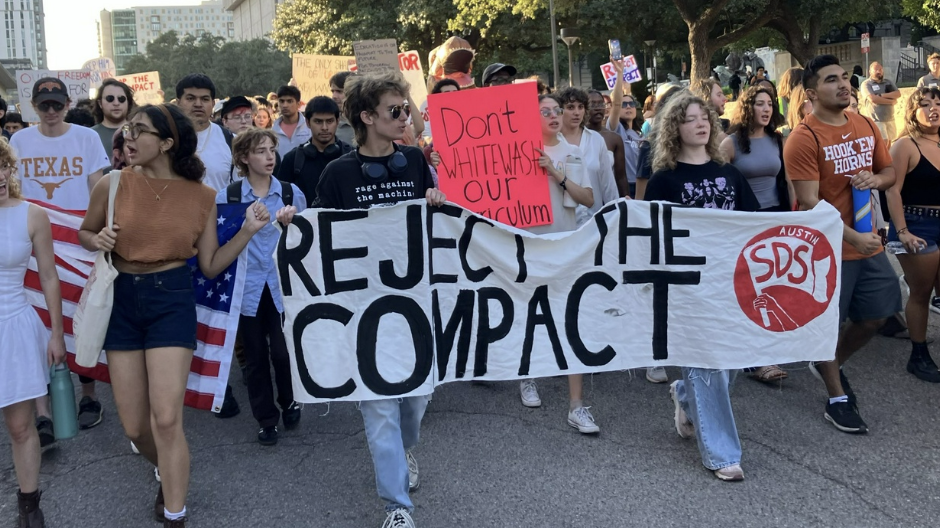
Photo courtesy of Fight Back! News.
All in all, Trump’s 2025 college program proposes changes that greatly impact fall 2026 applicants. They must examine the financial changes these policies bring, their impact on admissions, and how they may carry themselves on campus next year.